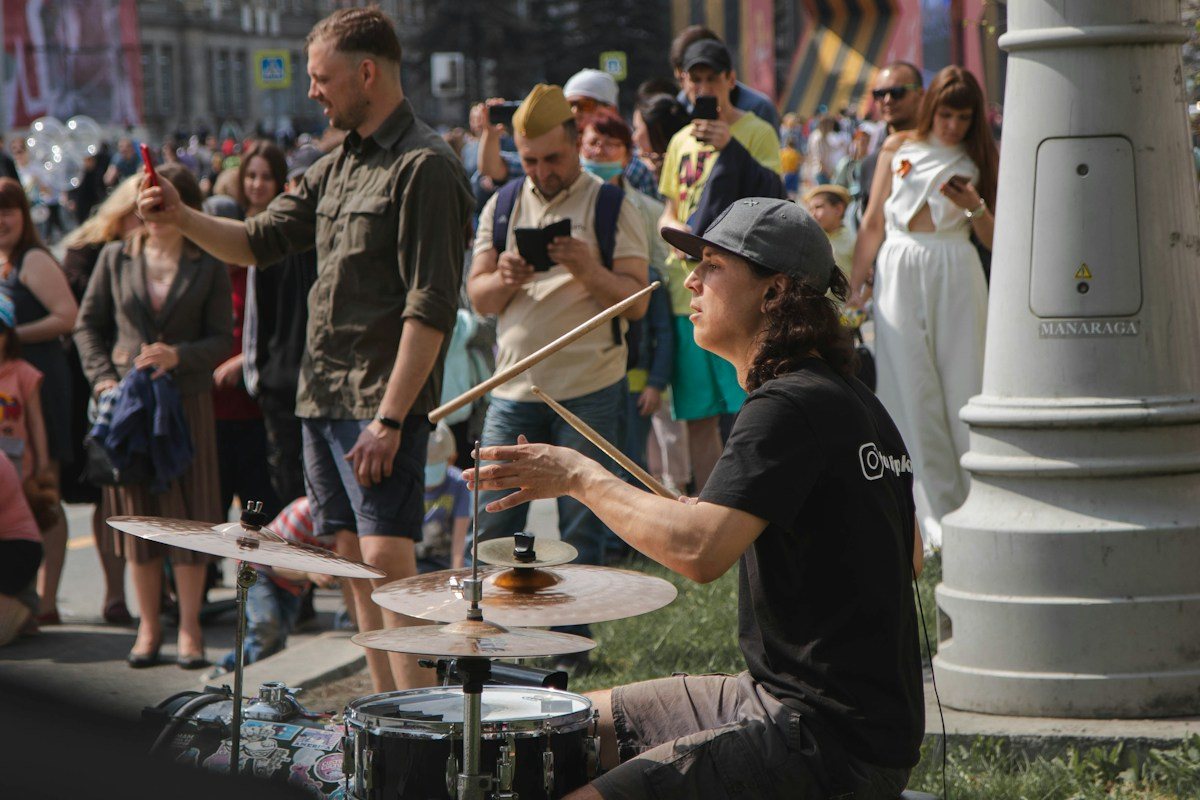
From a distance, a group of percussionists can sound like one large pattern. Come closer and individual parts begin to separate. A low, repeating pulse may hold the center while sharper sounds move around it. What seemed like everyone playing at once becomes a set of relationships.
The first pleasure is listening long enough to locate a repeated part. Follow it without trying to count every other sound. Then let your attention move to another player. The overall rhythm can seem to change even when the musicians haven't altered anything; you have changed what you are following.
Participation is a separate question. An open-air gathering isn't automatically an open invitation to pick up an instrument. Some groups are rehearsing, some are performing, and some welcome newcomers in a particular way. Look for an organizer or an explicit invitation rather than assuming that visible enthusiasm is all the permission needed.
If you are invited in, a simple, steady contribution can be more useful than an impressive one that competes with the group. Watch for cues about beginnings, changes, and endings. Listening doesn't stop when you start playing; it becomes more important.
And if you remain at the edge, that isn't a lesser experience. You can hear the give and take, notice who makes room, and feel a pattern settle without needing to claim part of it. Sometimes the most interesting position is the one from which you can hear everyone else.